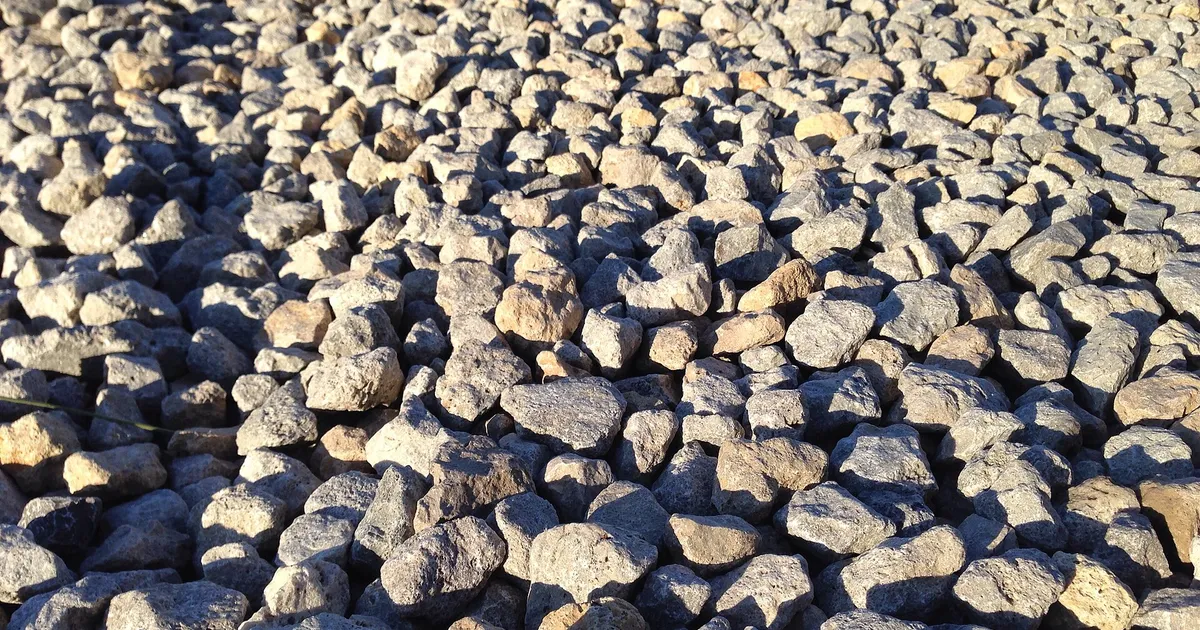
A 12 ft x 50 ft driveway built in three layers (4 in of base stone, 3 in of middle stone, 2 in of surface stone, all compacted) takes about 20 cubic yards, or roughly 28 tons, once you add a 20 % allowance for compaction. The same job priced as a single 9 in layer of one stone would be wrong in both volume and weight, because each layer is a different product with its own density.
This article rebuilds that number by hand, layer by layer, so you can check it against the gravel calculator and then swap in your own dimensions.
Why a driveway is three layers, not one
A new gravel driveway is not one deep pour of one stone. The usual build is a coarse base for strength, a smaller intermediate stone, and a dense surface layer. There is no single national depth: the Penn State Center for Dirt and Gravel Road Studies, which writes the specification for Pennsylvania's low-volume roads, places 6 to 8 in of surface aggregate (4.5 to 6 in once compacted) over a stone base, and asks for at least 12 in of stone over any separation fabric. Soft clay, fill or frost-prone ground calls for a thicker base, and a geotextile between the soil and the stone keeps the two from mixing.
The gravel calculator asks for the depth of one layer on purpose. Run it once per layer, add the results, and you get an order you can hand to a quarry as three separate lines. The gravel driveway calculator does the same in one pass, with a depth and a density for each of the three layers.
For this example, the plan is:
| Layer | Stone (typical choice) | Compacted depth | Density used |
|---|---|---|---|
| Base | Large clean stone such as No. 3 | 4 in | 1.35 tons per cu yd |
| Middle | Mid-size clean stone such as No. 57 | 3 in | 1.40 tons per cu yd |
| Surface | Crusher run or dense-graded aggregate | 2 in | 1.50 tons per cu yd |
These densities are planning figures for stone as delivered, not published constants. Bulk density is measured under ASTM C29, and the American Concrete Institute (Education Bulletin E1-07, page E1-15) reports that the dry-rodded bulk density of normal-weight aggregate generally runs from 75 to 110 lb per cubic foot. At 100 to 105 lb per cubic foot, the figure used here for No. 57 stone, one cubic yard weighs 1.35 to 1.42 tons (lb per cubic foot x 27 / 2,000). Loose stone straight from the pile can sit lower, and limestone, granite and trap rock differ. For dense-graded aggregate, the Penn State handbook's ordering rule of 0.03 tons per square foot for a 6 in loose lift works out to roughly 1.6 tons per loose cubic yard, so the 1.50 used for the surface layer is a planning value that sits in that neighbourhood. Your quarry's own number, printed on its product sheet or scale tickets, always wins.
Step 1: the area
The driveway is 12 ft wide and 50 ft long.
12 ft x 50 ft = 600 sq ft
If the drive widens at a turnaround or flares at the street, measure those pieces as separate rectangles and add them. The calculator's "I know the total square footage" option takes the sum directly.
Step 2: volume of each layer
For each layer, divide the depth in inches by 12 to get feet, then multiply by the area. Then add the compaction allowance.
| Layer | Depth in ft | Compacted volume | With 20 % compaction | Cubic yards (divide by 27) |
|---|---|---|---|---|
| Base | 4 / 12 = 0.333 | 600 x 0.333 = 200 cu ft | 200 x 1.2 = 240 cu ft | 8.89 |
| Middle | 3 / 12 = 0.25 | 600 x 0.25 = 150 cu ft | 150 x 1.2 = 180 cu ft | 6.67 |
| Surface | 2 / 12 = 0.167 | 600 x 0.167 = 100 cu ft | 100 x 1.2 = 120 cu ft | 4.44 |
The three layers add up to 20.00 cubic yards. A quick sanity check: 9 in is 0.75 ft, 600 x 0.75 = 450 cu ft, times 1.2 is 540 cu ft, and 540 / 27 is 20. The totals agree.
Step 3: convert each layer to tons
Quarries sell by weight, so multiply each layer's cubic yards by its own density.
| Layer | Cubic yards | Density | Tons |
|---|---|---|---|
| Base | 8.89 | 1.35 | 12.00 |
| Middle | 6.67 | 1.40 | 9.33 |
| Surface | 4.44 | 1.50 | 6.67 |
| Total | 20.00 | 28.00 |
If you had used a single 1.4 figure for everything, you would have ordered 28.0 tons as well, here by coincidence because the density differences cancel out. On a driveway with a much heavier surface layer or a thicker base, they would not. Splitting the layers costs nothing and keeps each line of the order honest.
Tons here are US short tons of 2,000 lb. Some quarries quote in metric tonnes; confirm the unit before you compare prices.
Step 4: how sure is the 20 % compaction figure?
Not very, and it is the biggest swing factor in the whole calculation.
Crushed stone arrives loose and loses volume as it is compacted. The calculator uses 20 %, a planning allowance. The only published ratio I could trace to a primary source comes from the Penn State Center for Dirt and Gravel Road Studies, which works on rural roads rather than driveways: its Driving Surface Aggregate Handbook (March 2018) places that aggregate at 6 in loose, compacted to 4½ in, or 8 in loose, compacted to 6 in. A 6 in loose layer for a 4.5 in result is a third more loose stone than the finished depth, not a fifth.
Here is what that does to this driveway:
| Allowance | Total volume | Tons (same densities) |
|---|---|---|
| 0 % (clean stone, no compaction) | 16.67 cu yd | 23.33 |
| 20 % (calculator default) | 20.00 cu yd | 28.00 |
| 33 % (Penn State loose-to-compacted ratio) | 22.22 cu yd | 31.11 |
Over a 600 sq ft drive the gap between the default and the cautious figure is about 3 tons. The right choice depends on the stone. A well-graded base with fines compacts a lot. Clean, single-size stone has few fines to fill its voids, so it loses less volume and can often be ordered with a smaller allowance. If you are mixing both on one job, tick the compaction box for the graded layers only and leave it off for the clean ones.
What the calculation does not include
The numbers above cover the stone that ends up in the finished layers. They leave out a few things that decide whether the order is enough:
- Soft ground. On a muddy or clay subgrade the first layer sinks in. A geotextile fabric slows that loss, and the Penn State handbook asks for at least 12 in of stone over separation fabric, so a thin three-layer build like this one suits firm ground rather than a soft subgrade.
- Spillage and uneven spreading. A few extra shovels at every load add up. Order slightly over rather than ordering a second small load.
- Moisture. Wet stone weighs more per cubic yard. A load delivered after rain can be heavier than the dry density you used.
Treat the 28 tons as the figure to confirm with the quarry, not a promise.
Lifts: why the layers are placed one at a time
Calculating by layer is not just bookkeeping. Each layer is spread and compacted before the next goes on, and the right thickness depends on the stone and the roller. For its driving surface aggregate, Penn State specifies a single loose lift of 6 to 8 in, compacted with a vibratory roller of at least 10 tons: thinner lifts do not bind, and thicker ones may not reach full compaction. PennDOT's Driving Surface Aggregate bulletin (IIB-06-31) gives the same 6 to 8 in uncompacted depth in one lift, compacted to 95 to 100 % of maximum dry density. Those rules are written for road equipment. With a plate compactor on a driveway, ask whoever is spreading the stone what lift thickness they plan, and adjust your layers to match.
Checking your own driveway
To rebuild the example for your own drive:
- Measure length and width in feet and multiply for the area.
- Choose a depth for each layer in inches, compacted, not loose.
- For each layer, work out cubic feet, add your compaction allowance, and divide by 27.
- Multiply each layer's cubic yards by the density the quarry gives you.
- Add the layers and round up to the next half ton.
If you pour a concrete apron where the drive meets the street, the concrete calculator handles the slab separately; it is a different material with different rules.
Open the gravel calculator, enter 12 ft by 50 ft, then run each layer at its own depth and density. You should land on 8.89, 6.67 and 4.44 cubic yards.
Frequently asked questions
How many tons of gravel do I need for a 12 x 50 driveway?
About 28 tons for a three-layer build of 4, 3 and 2 in compacted, with 20 % compaction allowance and densities of 1.35, 1.40 and 1.50 tons per cubic yard. A single 4 in layer of 1.4 ton stone over the same area, with the same allowance, is about 12.4 tons.
How deep should a gravel driveway be?
There is no single standard for driveways. This example uses 9 in compacted in three layers. Penn State's handbook asks for at least 12 in of stone over separation fabric, and soft or frost-prone soil calls for a thicker base. A top-up of an existing drive is usually only the surface layer, around 2 to 3 in.
Do I need to add extra for compaction on every layer?
Only on layers that are compacted and made of graded stone. Clean single-size stone and decorative stone lose less volume, so the allowance can be reduced or turned off for those.
Should I order by the cubic yard or by the ton?
Ask the quarry how they sell it. Most price by the ton and weigh the truck, so work out tons with their density. Volume is useful for checking that the delivered stone matches the space you have to fill.
Why does the calculator ask for density?
Because tons per cubic yard is a property of the stone, not a constant. The calculator defaults to 1.4 and lets you enter the number your quarry gives you.
Sources
- Penn State Center for Dirt and Gravel Road Studies, Driving Surface Aggregate (DSA) Handbook, March 2018 (pages 10 and following), dirtandgravel.psu.edu
- Pennsylvania Department of Transportation, Driving Surface Aggregate, Innovation Implementation Bulletin IIB-06-31, penndot.pa.gov
- American Concrete Institute, Aggregates for Concrete, Education Bulletin E1-07, concrete.org
- ASTM International, ASTM C29/C29M, Standard Test Method for Bulk Density (Unit Weight) and Voids in Aggregate, astm.org